
The Sea of Lost Memory. Access Denied
Відкритий проєкт
Діючий 3 months, 3 тижнів тому
Group Leadership
- Адміністратори проєкту
-
-

The project “The Sea of Lost Memory. Access Denied” works with the theme of collective and personal memory as an unstable, fragile archive that cannot be fully fixed or preserved – neither on physical media nor in the digital cloud.
At the core of the project is a found roll of film that my parents left undeveloped in an analog camera approximately 20 years ago. In 2025, I received this camera and developed the film, which revealed fragments of my childhood that I no longer remember, just as I no longer know the exact time when the photographs were taken. Some of these images were made in Crimea – a place that today is occupied and physically inaccessible, yet continues to exist in memory.
These accidentally preserved images became a point of departure for reflections on the nature of memory. Memory is fragmentary and unreliable, similar to a dream: after waking, only certain images remain, while the rest disappear. From a physiological perspective, memory has no single place of storage; it exists as a network of connections between neurons, distributed across different areas of the brain. A memory is reconstructed anew each time it is recalled and changes slightly each time. Without a material trace, many moments could vanish forever.
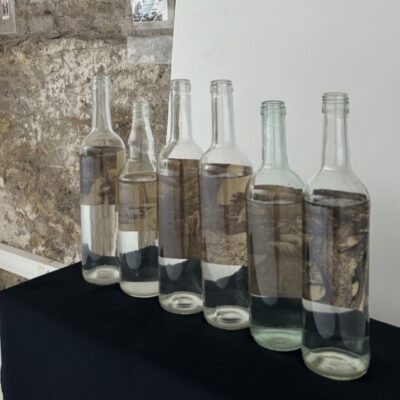
Within the framework of “The Sea of Lost Memory. Access Denied,” the photographs are printed using the cyanotype process – a fragile and short-lived technique that is difficult to conserve. The prints are placed in glass bottles filled with saline solutions of varying concentrations. Some of the bottles contain water with a salt concentration identical to that of the Black Sea; others contain a concentration equivalent to that of human blood. This simultaneously refers to the salt water of the Black Sea, access to parts of which has been lost due to occupation, as well as to the occupation of Donbas: for the solution, I use salt from the mines of Soledar, whose extraction was halted in April 2022 (for the first time since the Second World War) due to shelling by the Russian army.
During the exhibition process, the images gradually deteriorate under the influence of salt and water. The speed and character of this degradation vary, just as the mechanisms of memory’s disappearance do. The project has no fixed final state, as the images are destroyed over time. It is an ephemeral attempt to fix experiences, memories, and places that are no longer physically accessible, yet continue to live in collective and personal memory.
“The Sea of Lost Memory. Access Denied” is a reflection on the limits of preservation, on war as a factor in the formation of new memory, and on the impossibility of “uploading to the cloud” human experience, which always remains vulnerable.

Деталі проєкту
The project “The Sea of Lost Memory. Access Denied” works with the theme of collective and personal memory as an unstable, fragile archive that cannot be fully fixed or preserved – neither on physical media nor in the digital cloud.
At the core of the project is a found roll of film that my parents left undeveloped in an analog camera approximately 20 years ago. In 2025, I received this camera and developed the film, which revealed fragments of my childhood that I no longer remember, just as I no longer know the exact time when the photographs were taken. Some of these images were made in Crimea – a place that today is occupied and physically inaccessible, yet continues to exist in memory.
These accidentally preserved images became a point of departure for reflections on the nature of memory. Memory is fragmentary and unreliable, similar to a dream: after waking, only certain images remain, while the rest disappear. From a physiological perspective, memory has no single place of storage; it exists as a network of connections between neurons, distributed across different areas of the brain. A memory is reconstructed anew each time it is recalled and changes slightly each time. Without a material trace, many moments could vanish forever.
Within the framework of “The Sea of Lost Memory. Access Denied,” the photographs are printed using the cyanotype process – a fragile and short-lived technique that is difficult to conserve. The prints are placed in glass bottles filled with saline solutions of varying concentrations. Some of the bottles contain water with a salt concentration identical to that of the Black Sea; others contain a concentration equivalent to that of human blood. This simultaneously refers to the salt water of the Black Sea, access to parts of which has been lost due to occupation, as well as to the occupation of Donbas: for the solution, I use salt from the mines of Soledar, whose extraction was halted in April 2022 (for the first time since the Second World War) due to shelling by the Russian army.
During the exhibition process, the images gradually deteriorate under the influence of salt and water. The speed and character of this degradation vary, just as the mechanisms of memory’s disappearance do. The project has no fixed final state, as the images are destroyed over time. It is an ephemeral attempt to fix experiences, memories, and places that are no longer physically accessible, yet continue to live in collective and personal memory.
“The Sea of Lost Memory. Access Denied” is a reflection on the limits of preservation, on war as a factor in the formation of new memory, and on the impossibility of “uploading to the cloud” human experience, which always remains vulnerable.
