
CHILDREN BORN DURING WAR
Project
Active 1 day, 11 hours ago
Group Leadership
- Project Initiators
-
-

This project brings together a series of portraits of children born during the full-scale war in Ukraine. It does not aim to document events directly; instead, it traces their presence where they are least visible and most profound — in a child’s face, in a gaze, in a state of being.
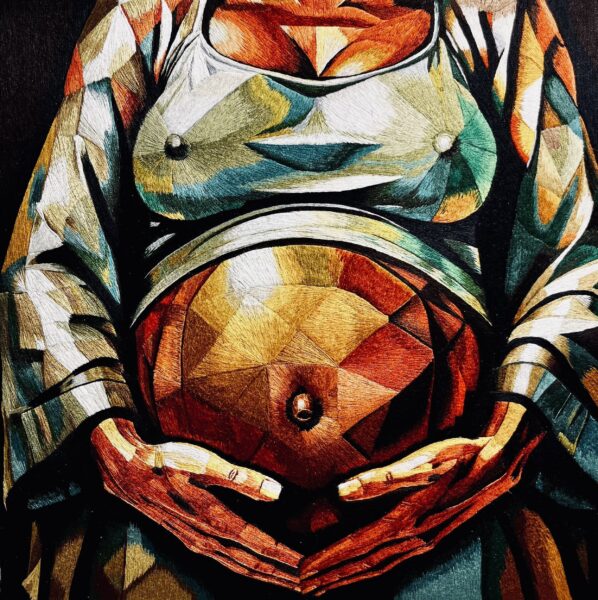
These works exist at the intersection of portraiture and inner landscape. They do not pursue likeness as an end in itself; rather, they focus on emotional and psychological tension, expressed through color, rhythm, and structure. Fragmented forms, sharp transitions, and contrasting combinations create a visual language that reflects both the rupture of experience and the attempt to reassemble it.
The use of embroidery in this project moves beyond its traditional or decorative function. Here, it becomes a method of thinking and a process of restoration. Each stitch is an act of gathering, of slowing down, of holding attention. In this sense, the works can be seen as a meditative practice that resists chaos — quiet, persistent, and deliberate.
Rooted in the Ukrainian context, this project reflects a reality in which war has become not only an event, but an environment — something that shapes daily life, perception, and even the earliest stages of human experience. These children have not yet formed memories in the conventional sense, yet they already exist within a field of historical tension. Their images carry a presence that is not narrative, but atmospheric — shaped by what surrounds them, even before it can be understood.
At the same time, the exhibition speaks beyond a single geography. It raises broader questions about how identity forms under pressure, how unarticulated experience finds visual expression, and how art can serve as a space where fragmentation is held, if not fully resolved.
The exhibition does not seek to illustrate war or to appeal to direct empathy. Instead, it creates a space for attentive viewing and quiet encounter. The viewer is invited not so much to interpret, as to remain present — to stay with these faces, these gazes, these states.
There are no grand gestures here. The work unfolds through a concentrated stillness — through a gaze that may be difficult to sustain, yet equally difficult to turn away from.

Project info
This project brings together a series of portraits of children born during the full-scale war in Ukraine. It does not aim to document events directly; instead, it traces their presence where they are least visible and most profound — in a child’s face, in a gaze, in a state of being.
These works exist at the intersection of portraiture and inner landscape. They do not pursue likeness as an end in itself; rather, they focus on emotional and psychological tension, expressed through color, rhythm, and structure. Fragmented forms, sharp transitions, and contrasting combinations create a visual language that reflects both the rupture of experience and the attempt to reassemble it.
The use of embroidery in this project moves beyond its traditional or decorative function. Here, it becomes a method of thinking and a process of restoration. Each stitch is an act of gathering, of slowing down, of holding attention. In this sense, the works can be seen as a meditative practice that resists chaos — quiet, persistent, and deliberate.
Rooted in the Ukrainian context, this project reflects a reality in which war has become not only an event, but an environment — something that shapes daily life, perception, and even the earliest stages of human experience. These children have not yet formed memories in the conventional sense, yet they already exist within a field of historical tension. Their images carry a presence that is not narrative, but atmospheric — shaped by what surrounds them, even before it can be understood.
At the same time, the exhibition speaks beyond a single geography. It raises broader questions about how identity forms under pressure, how unarticulated experience finds visual expression, and how art can serve as a space where fragmentation is held, if not fully resolved.
The exhibition does not seek to illustrate war or to appeal to direct empathy. Instead, it creates a space for attentive viewing and quiet encounter. The viewer is invited not so much to interpret, as to remain present — to stay with these faces, these gazes, these states.
There are no grand gestures here. The work unfolds through a concentrated stillness — through a gaze that may be difficult to sustain, yet equally difficult to turn away from.
